
For graduates and engineers across India dreaming of a career at India’s airports, the Airports Authority of India genuinely offers something distinct from most government recruitment — a Junior Executive role that could mean anything from managing fire safety operations to guiding aircraft through busy airspace as an Air Traffic Controller, or even joining through your GATE score if you’re an engineering graduate. With over 1,200 vacancies expected across Fire Services, Human Resources, and Official Language disciplines this cycle, alongside separate recruitment drives for Air Traffic Control and engineering streams, AAI genuinely represents one of the more varied and interesting public sector career paths available today. But here’s what makes preparing for this exam genuinely confusing for many aspirants: AAI actually runs three distinctly different recruitment pathways for Junior Executive posts, each with its own selection process — meaning candidates who don’t confirm exactly which stream they’re applying for often end up preparing for the wrong exam structure entirely.
Let’s break down everything you need to know.
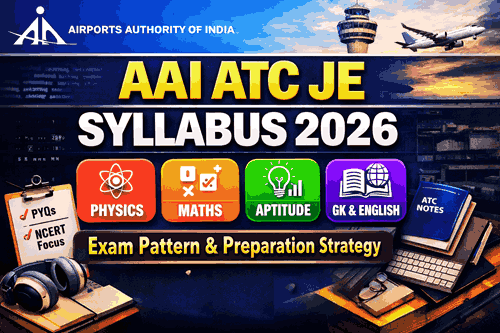
AAI Junior Executive 2026: Quick Overview
| Particulars | Details |
| Conducting Body | Airports Authority of India (AAI) |
| Recruitment Streams | Junior Executive (Fire Services, HR, Official Language), Junior Executive (Air Traffic Control – ATC), Junior Executive (Engineering — via GATE score) |
| Expected Vacancies (General JE) | 1,200+ |
| Selection Stages (General JE) | Online Written Test, Physical Measurement Test, Driving Test (for Fire Services), Document Verification |
| Selection Stages (JE-ATC) | Computer-Based Test (CBT), Voice Test, Medical Examination, Document Verification, Final Merit |
| Selection Basis (JE-Engineering) | Valid GATE scorecard — no separate written exam |
| Pay Level | Approximately Rs. 40,000 to Rs. 1,40,000 (with periodic increments) |
| Official Website | aai.aero |
Since these three recruitment streams follow genuinely different selection processes, confirming exactly which pathway applies to your qualification and career interest is the essential first step before you start preparing.
Understanding the Three Distinct AAI Junior Executive Pathways
This is genuinely the most important clarification to make before diving into preparation. AAI doesn’t run a single uniform Junior Executive recruitment process — it operates through three genuinely distinct pathways depending on the discipline you’re applying for.
Junior Executive (Fire Services, HR, Official Language) follows a traditional written exam-based selection process, testing general aptitude subjects through an online CBT.
Junior Executive (Air Traffic Control – ATC) follows a specialised CBT structure that genuinely tests technical Physics and Mathematics knowledge alongside general aptitude, given the safety-critical nature of air traffic control work.
Junior Executive (Engineering streams like Architecture, Civil, Electrical, Electronics, and IT) doesn’t involve a separate written exam at all — selection happens purely based on your valid GATE scorecard, making this pathway genuinely different from the other two.
Given how significantly these three pathways differ, candidates need to identify exactly which stream matches their qualification and interest before committing to any specific preparation plan.
Junior Executive (Fire Services, HR, Official Language): Selection Process
For candidates applying to these specific disciplines, the selection process includes:
- Online Written Test — the primary screening stage testing general aptitude subjects
- Physical Measurement Test — relevant particularly for Fire Services posts, verifying physical standards
- Driving Test — specifically required for Fire Services candidates, given the practical demands of this role
- Document Verification — confirming eligibility and academic credentials
Since Fire Services candidates specifically face additional physical and driving test requirements beyond the written exam, candidates targeting this discipline need to prepare for both academic and practical components simultaneously, rather than assuming the written test alone determines their selection.
General Junior Executive Written Test Syllabus
The written test for Fire Services, HR, and Official Language posts covers standard competitive exam subjects, including:
- General Intelligence and Reasoning
- General Awareness
- English Comprehension
- Quantitative Aptitude
General Intelligence and Reasoning
This section evaluates logical and analytical thinking through both verbal and non-verbal reasoning formats, covering analogies, series completion, coding-decoding, blood relations, and puzzle-based questions.
General Awareness
This section covers current affairs, static general knowledge, and broader societal awareness expected of any competitive exam candidate.
English Comprehension
This section tests grammar, vocabulary, and comprehension skills, covering reading comprehension, error spotting, and vocabulary-based questions.
Quantitative Aptitude
This section tests calculation speed and applied mathematical reasoning, covering foundational arithmetic, percentage, ratio, and time-based calculations.
Since this syllabus follows a fairly standard competitive exam structure, candidates with prior preparation experience from other government exams often find this component genuinely manageable with consistent revision.
Junior Executive (Air Traffic Control – ATC): Understanding the Two-Part Structure
The AAI JE-ATC exam follows a genuinely more technical structure compared to the general Junior Executive pathway, since Air Traffic Control demands strong foundational science knowledge alongside general aptitude.
The CBT is divided into two parts:
Part A covers four sections — Reasoning, English Language, General Aptitude/Numerical Ability, and General Knowledge/Awareness.
Part B covers two technical sections — Mathematics and Physics, based on the Class 11 and 12 NCERT curriculum.
The exam is conducted online in both English and Hindi, with each correct answer earning 1 mark and no negative marking applied, allowing candidates to attempt every question without fear of losing marks for incorrect answers.
Why Physics Genuinely Decides AAI ATC Selection
A genuinely important insight for JE-ATC aspirants is that Physics carries the highest practical weightage in determining actual selection outcomes, since most candidates’ final rankings are decided by their accuracy and familiarity with Physics concepts and previous year question patterns specifically. Given this, candidates targeting ATC posts should treat Physics revision — drawn from Class 11 and 12 NCERT textbooks — as their genuine top priority, rather than distributing preparation time evenly across all six sections.
Part A Syllabus for JE-ATC (General Aptitude Component)
This component mirrors the general Junior Executive written test structure, covering Reasoning, English Language, General Aptitude/Numerical Ability, and General Knowledge/Awareness at a level comparable to standard competitive exam preparation.
Part B Syllabus for JE-ATC (Technical Component)
This component tests genuinely specialised subject knowledge:
Physics, based on Class 11 and 12 NCERT concepts, forms the deciding subject for most candidates’ selection outcomes, making thorough, systematic revision of core physics topics genuinely essential.
Mathematics similarly draws from the 10+2 level curriculum, testing foundational mathematical concepts relevant to the analytical demands of air traffic control work.
Given how directly this technical component connects to actual selection outcomes, JE-ATC aspirants need to dedicate the bulk of their preparation time to Physics and Mathematics, treating the general aptitude Part A as a supporting component rather than their primary focus.
Junior Executive (Engineering Streams): Understanding the GATE-Based Selection
For candidates applying to Junior Executive posts in Architecture, Civil Engineering, Electrical Engineering, Electronics, and Information Technology, AAI’s selection process works genuinely differently from both the general JE and JE-ATC pathways. Rather than conducting a separate written examination, AAI selects candidates purely based on their valid GATE (Graduate Aptitude Test in Engineering) scorecard from the relevant qualifying year.
Since this pathway doesn’t involve a distinct AAI-specific written test, candidates interested in these engineering disciplines need to focus their preparation entirely on performing well in GATE itself, rather than expecting a separate AAI-specific exam to prepare for. Only candidates who’ve completed their engineering degree in the relevant branch and hold a valid GATE score within AAI’s specified validity window become eligible to apply through this pathway.
Why Confirming Your Exact Recruitment Stream Matters So Much
Given how genuinely different these three pathways are — traditional written exam for Fire Services/HR/Official Language, specialised technical CBT for ATC, and GATE-based selection for engineering streams — candidates need to identify their exact target stream before committing to any preparation plan. A candidate preparing generically for “AAI Junior Executive” without this confirmation risks either studying content irrelevant to their actual exam, or worse, missing the fact that their pathway doesn’t even require a separate written test at all.
Building an Effective Preparation Strategy
Given the three distinct pathways, your preparation strategy needs to align precisely with your specific target stream.
If you’re targeting Fire Services, HR, or Official Language posts, build steady competency across General Intelligence, General Awareness, English Comprehension, and Quantitative Aptitude, while simultaneously maintaining physical fitness training if you’re specifically targeting Fire Services, given the additional Physical Measurement Test and Driving Test requirements.
If you’re targeting JE-ATC, dedicate the majority of your preparation time to Physics, thoroughly revising Class 11 and 12 NCERT concepts and solving previous year questions repeatedly, since this subject genuinely decides most selection outcomes. Build supporting competency in Mathematics and the general aptitude Part A sections, but recognise that Physics accuracy remains your primary differentiator.
If you’re targeting engineering streams through the GATE-based pathway, focus your entire preparation energy on performing well in GATE itself, since there’s no separate AAI-specific exam to prepare for — your GATE score is genuinely the sole determining factor for this recruitment stream.
FAQs
Q1. How do I know which of the three AAI Junior Executive pathways applies to me?
This depends entirely on which specific discipline you’re applying for — Fire Services, HR, and Official Language follow the traditional written exam pathway, Air Traffic Control follows its own specialised CBT structure, and Engineering streams like Civil or Electrical follow the GATE-based selection process, so confirming your target discipline against the official notification clarifies exactly which pathway and preparation approach applies to you.
Q2. Since Physics is described as the deciding subject for JE-ATC, should I neglect the general aptitude Part A sections entirely?
Not entirely — while Physics genuinely carries the most weight in determining actual selection outcomes, Part A’s Reasoning, English, Numerical Ability, and General Knowledge still contribute to your overall score, so maintaining reasonable, consistent preparation here remains necessary even though your greater intensive preparation should concentrate on Physics.
Q3. If I’m applying for engineering streams through GATE, do I need to prepare separately for any AAI-specific exam?
No, since selection for these engineering disciplines happens purely based on your valid GATE scorecard, there’s no separate AAI-specific written test to prepare for — your entire preparation effort should focus on performing well in GATE itself within its relevant validity window for AAI’s recruitment.
Q4. Since Fire Services candidates face additional Physical Measurement and Driving Tests, when should I start preparing for these practical components?
It’s genuinely better to start building physical fitness and driving skills consistently throughout your written exam preparation period, rather than waiting until after clearing the written test, since developing genuine competency in these practical areas takes sustained time and shouldn’t be compressed into a short window between stages.