
For thousands of graduates across India, ESIC Upper Division Clerk recruitment genuinely represents one of the most sought-after Central Government clerical postings available today — a Group C, Non-Gazetted role under the Ministry of Labour and Employment, offering genuine job stability, a comfortable Pay Level 4 salary bringing home roughly Rs. 38,000 to Rs. 44,000 monthly, and structured administrative work across ESIC’s hospitals, offices, and regional branches nationwide. But here’s what makes this exam genuinely worth understanding carefully before you commit months of preparation: your Prelims performance, however strong, doesn’t count toward your final merit at all — it’s purely a screening filter shortlisting roughly ten candidates per available seat for Mains — meaning candidates who pour disproportionate preparation intensity into Prelims while neglecting Mains and the concluding Computer Skill Test genuinely risk stumbling at the stages that actually decide their selection.
Let’s break down everything you need to know.
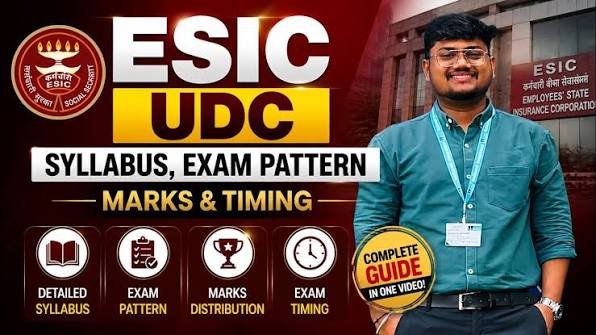
ESIC UDC 2026: Quick Overview
| Particulars | Details |
| Conducting Body | Employees’ State Insurance Corporation (ESIC) |
| Post | Upper Division Clerk (UDC) |
| Post Category | Group C, Non-Gazetted, Ministerial |
| Expected Vacancies | 500 to 2,000 |
| Age Limit | 18 to 27 years |
| Basic Eligibility | Graduate degree; working knowledge of computers (office suites and databases) |
| Selection Stages | Prelims, Mains, Computer Skill Test |
| Prelims Nature | Qualifying only — marks not counted in final merit |
| Prelims Questions | 100, worth 200 marks (2 marks each) |
| Prelims Duration | 1 hour |
| Prelims Shortlisting Ratio | 1:10 (10 candidates compete per seat) |
| Negative Marking | 0.25 (1/4) marks deducted per wrong answer |
| Computer Skill Test | Qualifying — marks not counted in final merit |
| Salary (Pay Level 4, 7th CPC) | Rs. 25,500 to Rs. 81,100 |
| Official Website | esic.gov.in |
Since Prelims marks genuinely don’t contribute to your final merit at all, and the Computer Skill Test is also purely qualifying despite tripping up many candidates who underprepare for it, understanding exactly where your genuine scoring priority lies is essential before you start studying.
Understanding the Three-Stage Selection Process
ESIC UDC recruitment runs through a genuinely comprehensive three-stage process, with each stage testing distinctly different skills before final selection.
The complete process includes:
- Prelims — a qualifying screening test shortlisting candidates for Mains
- Mains — the genuinely merit-deciding stage combining objective and descriptive testing
- Computer Skill Test — a qualifying practical assessment of computer proficiency
Since Prelims marks don’t carry forward into your final merit calculation, your most intensive, sustained preparation effort should genuinely concentrate on Mains, which is where your actual selection outcome gets decided.
Prelims Exam Pattern
The Preliminary Examination consists of 100 objective-type questions worth 200 marks, to be completed within 1 hour. The syllabus spans:
- General Intelligence and Reasoning
- General Awareness
- Quantitative Aptitude
- English Language/Comprehension
Negative marking applies at 0.25 marks deducted per wrong answer, so candidates need to approach uncertain questions with genuine caution rather than guessing liberally throughout the paper. Given the competitive 1:10 shortlisting ratio, candidates need to clear this stage comfortably, though the intensity you invest here should still leave room for genuinely deeper Mains preparation, since these Prelims marks themselves won’t count toward your final selection.
General Intelligence and Reasoning Syllabus
This section evaluates logical and analytical thinking through both verbal and non-verbal reasoning formats, covering analogies, series completion, coding-decoding, blood relations, and puzzle-based questions. Since this section rewards consistent practice more than memorisation, regular timed practice sessions genuinely build the speed and accuracy needed within Prelims’ compressed 1-hour duration.
Quantitative Aptitude Syllabus
This section tests calculation speed and applied mathematical reasoning, and a genuinely useful insight worth knowing is that ESIC UDC’s Quantitative Aptitude isn’t as advanced as banking PO exams, focusing instead on arithmetic-heavy topics like percentages, profit and loss, time and work, and data interpretation. Given this comparatively accessible difficulty level, consistent daily practice — aiming to solve around 25 questions within roughly 15 minutes with a timer — genuinely builds the speed this section demands.
English Language Syllabus
This section tests grammar, vocabulary, and comprehension skills, covering reading comprehension, error spotting, sentence correction, fill in the blanks, and vocabulary-based questions. Since English carries forward significance into Mains’ descriptive component as well, building genuine grammar fundamentals here benefits your preparation across both stages.
General Awareness Syllabus
This section covers current affairs, static general knowledge, and broader societal awareness expected of any competitive exam candidate. Given how directly this connects to genuinely ongoing developments, consistent daily reading throughout your preparation period builds the depth this section demands far more effectively than last-minute cramming.
Main Exam Pattern: Where Your Actual Selection Gets Decided
Since Prelims doesn’t count toward your final merit, Mains is genuinely where your selection outcome depends. This stage combines objective testing across similar subject themes at a more advanced level, alongside a descriptive component focusing specifically on essay writing and letter writing.
The same negative marking scheme of 1/4 mark per wrong answer applies to the objective portion. Given that a net score of roughly 140 to 150 out of 200 comfortably clears cutoffs for most categories and regions in recent cycles, candidates should aim to build genuine accuracy and consistency across Mains rather than assuming Prelims-level preparation automatically translates to strong Mains performance.
Why the Descriptive Component Deserves Genuine, Dedicated Practice
Since Mains includes essay writing and letter writing components testing structured written expression rather than simply selecting correct objective options, candidates who’ve only practiced objective-style questions throughout their preparation often find themselves genuinely underprepared for this format. Building regular practice in constructing clear, well-organised essays and formal letters — rather than assuming strong grammar knowledge alone covers this component — matters considerably for your overall Mains score.
Computer Skill Test: The Stage Many Candidates Genuinely Underestimate
Following Mains, candidates move to the Computer Skill Test, which is qualifying in nature — meaning marks here don’t count toward your final merit. However, a genuinely important insight worth internalising is that many candidates fail this stage specifically because they neglect MS Office practice, assuming basic computer familiarity automatically suffices.
Given that this test genuinely evaluates working proficiency in Word, Excel, and PowerPoint, candidates should dedicate consistent, ongoing practice time here — ideally starting from around the second month of their overall preparation timeline, spending 15 to 20 minutes daily building genuine hands-on familiarity with these applications — rather than treating this as a formality to address only after clearing Mains.
Why Starting Your Preparation Early Genuinely Matters
Given the genuinely comprehensive syllabus spanning Quantitative Aptitude, Reasoning, English, General Awareness, and practical computer skills, experienced educators consistently recommend beginning your preparation 4 to 6 months before the expected notification date. This timeline allows you to build a genuinely strong foundation in the more time-consuming subjects like Quantitative Aptitude and Reasoning, while also giving you ample opportunity to cover at least six months of current affairs and consistently practice MS Office skills well ahead of your Computer Skill Test.
Building an Effective Preparation Strategy
Given the three-stage structure with genuinely different stakes — Prelims qualifying, Mains merit-deciding, Computer Skill Test qualifying but frequently underestimated — your preparation strategy needs to reflect where your genuine effort should concentrate throughout your entire study timeline.
In your initial preparation phase, build strong fundamentals across General Intelligence and Reasoning, Quantitative Aptitude, English Language, and General Awareness, since these carry forward into Mains at a more advanced level, making early investment here doubly useful even though Prelims itself is only qualifying. Given the negative marking scheme, practice with measured confidence rather than liberal guessing.
Once you’re confident about clearing Prelims, shift your primary, sustained preparation effort toward Mains, deepening your objective preparation while building consistent essay and letter writing practice for the descriptive component. Simultaneously, begin dedicated MS Office practice early in your preparation timeline — rather than waiting until after Mains — ensuring you’re genuinely ready for the Computer Skill Test that trips up so many otherwise well-prepared candidates.
Regular practice with previous year question papers across both Prelims and Mains helps you understand exactly how ESIC frames questions at each stage, while consistent daily current affairs reading strengthens what’s often a reliably scoring, ongoing preparation component throughout your entire study timeline.
FAQs
Q1. Since Prelims marks don’t count toward my final merit at all, is it safe to prepare for it less intensively than Mains?
Not entirely — while Prelims marks don’t carry forward, you still need to clear this qualifying stage comfortably given the competitive 1:10 shortlisting ratio, so consistent preparation across all four subjects remains necessary, even though your greater long-term intensive preparation should shift toward Mains once you’re confident about clearing Prelims.
Q2. Why do so many candidates reportedly fail the Computer Skill Test despite it being qualifying and seemingly straightforward?
Given that many candidates assume basic computer familiarity automatically suffices and consequently neglect dedicated MS Office practice, they often find themselves underprepared for this test’s genuine hands-on evaluation of Word, Excel, and PowerPoint proficiency, making consistent, ongoing practice throughout your preparation timeline essential rather than optional.
Q3. Is ESIC UDC’s Quantitative Aptitude genuinely easier compared to typical banking exam mathematics?
Yes, generally so — ESIC UDC’s Quantitative Aptitude focuses on more accessible, arithmetic-heavy topics like percentages, profit and loss, and time and work, rather than the more advanced concepts typically tested in banking PO exams, though building genuine calculation speed through consistent daily timed practice still matters for performing well within the compressed exam duration.
Q4. How early should I realistically start my ESIC UDC preparation given the exam’s comprehensive syllabus?
Experienced educators generally recommend starting 4 to 6 months before the expected notification date, since this timeline allows you to build strong foundations in time-consuming subjects like Quantitative Aptitude and Reasoning, cover several months of current affairs, and practice MS Office skills consistently, rather than rushing through the entire syllabus in a compressed window closer to your actual exam.