
For graduates across India dreaming of a stable, respected career combining administrative authority with social welfare impact, ESIC Social Security Officer recruitment offers something genuinely meaningful — a Central Government post under the Employees’ State Insurance Corporation, an organisation directly responsible for providing health and social security benefits to millions of workers nationwide. Whether you’re aiming for the Social Security Officer, Manager Grade II, or Superintendent post, this recruitment genuinely represents one of the more attractive government job opportunities blending banking-style exam preparation with a genuinely rewarding social welfare mission. But here’s what makes this exam demand a specifically calibrated preparation strategy: your Prelims performance, however strong, doesn’t count toward your final merit at all — it’s purely a screening hurdle — meaning candidates who pour excessive preparation intensity into Prelims while treating Mains as a secondary concern genuinely misallocate their effort compared to where their actual selection outcome gets decided.
Let’s break down everything you need to know.
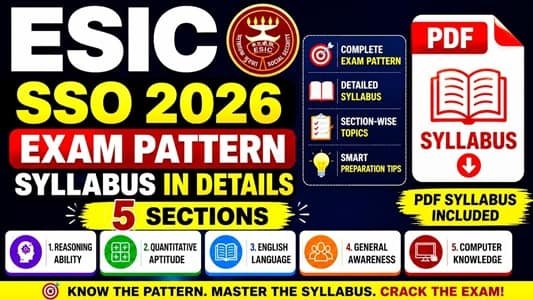
ESIC SSO 2026: Quick Overview
| Particulars | Details |
| Conducting Body | Employees’ State Insurance Corporation (ESIC) |
| Posts Covered | Social Security Officer, Manager Grade II, Superintendent |
| Selection Stages | Prelims (Phase I), Mains (Phase II), Computer Skill Test and Descriptive Test |
| Prelims Nature | Qualifying only — marks not counted in final merit |
| Prelims Negative Marking | 0.25 marks deducted per wrong answer |
| Prelims Shortlisting Ratio | 1:10 (10 times the vacancies per category) advance to Mains |
| Mains Sections | English Language, Reasoning Ability, Quantitative Aptitude, General Awareness |
| Final Stage | Computer Skill Test (MS Office) + English Descriptive Test (2 questions) |
| Prelims Exam Date (Expected) | August 2026 |
| Official Website | esic.gov.in |
Since Prelims genuinely doesn’t count toward your final merit at all, understanding this distinction early on shapes exactly where your intensive preparation effort should concentrate throughout your entire study timeline.
Understanding the Three-Stage Selection Process
ESIC SSO recruitment runs through a comprehensive three-stage process, testing general aptitude first before moving into more comprehensive testing and practical skill assessment.
The complete process includes:
- Prelims (Phase I) — a qualifying screening test, common in structure to standard banking exams
- Mains (Phase II) — the genuinely decisive objective test determining your merit
- Computer Skill Test and Descriptive Test — the concluding practical assessment
Since candidates must qualify each stage sequentially, and Prelims marks specifically don’t carry forward into your final merit calculation, your genuine scoring priority should shift decisively toward Mains once you’re confident about clearing Prelims comfortably.
Prelims Exam Pattern
The Preliminary Examination consists of objective-type questions divided into three sections:
- English Language
- Reasoning Ability
- Quantitative Aptitude
Negative marking applies at 0.25 marks deducted per wrong answer. Since Prelims serves purely as a qualifying stage — candidates advance to Mains based on their performance here, but these specific marks don’t count toward your final merit — you need to clear this stage comfortably while reserving your most intensive preparation depth for Mains, which is what actually determines your selection.
Given that candidates get shortlisted for Mains at a ratio of 1:10 relative to vacancies within each category, competition genuinely intensifies at this screening stage, making thorough Prelims preparation essential even though these marks themselves won’t carry forward.
English Language Syllabus
This section tests grammar, vocabulary, and comprehension skills, covering a genuinely extensive range of topics including:
- Synonyms, homonyms, and antonyms
- Spelling and word formation
- Idioms and phrases
- Fill in the blanks
- Grammar and spotting errors
- Sentence correction
- Active and passive voice
- Direct and indirect speech
- Reading comprehension
- Passage completion
- Theme detection
- Deriving conclusions
- Rearrangement of passages
Since this syllabus remains largely consistent between Prelims and Mains, though tested at potentially greater depth in Mains, building strong foundational grammar and comprehension skills genuinely benefits you across both stages.
Reasoning Ability Syllabus
This section evaluates logical and analytical thinking through both verbal and non-verbal reasoning formats, covering standard topics like puzzles, seating arrangement, syllogism, coding-decoding, and blood relations. Since this section rewards consistent practice more than memorisation, regular timed practice sessions genuinely build the speed and accuracy needed within the exam’s time constraints.
Quantitative Aptitude Syllabus
This section tests calculation speed and applied mathematical reasoning, covering:
- Percentages
- Ratio and proportion
- Averages
- Mixture and allegation
Alongside these specific topics, this section typically also covers standard banking-exam mathematics areas including simplification, data interpretation, profit and loss, and time and work calculations. Since Data Interpretation questions often carry more scoring potential once you’ve built the right calculation shortcuts, prioritising accuracy in DI sets tends to be a smarter strategy than rushing through scattered standalone arithmetic problems.
Main Exam Pattern: Where Your Actual Selection Gets Decided
Since Prelims marks don’t carry forward, Mains is genuinely where your selection outcome depends. The Mains exam expands to four sections:
- English Language
- Reasoning Ability
- Quantitative Aptitude
- General Awareness
Given that General Awareness appears only in Mains and not in Prelims, candidates need dedicated preparation for this entirely new component, rather than assuming their Prelims-level preparation across English, Reasoning, and Quantitative Aptitude automatically extends to cover this genuinely distinct subject.
General Awareness Syllabus (Mains Only)
This section carries genuine significance within Mains, testing awareness relevant to the banking and financial sector specifically, given ESIC’s connection to social security and financial administration. Core topics include:
- Banking terms
- Abbreviations and economic terminologies
- Overview of the Indian Financial System
- History of the Indian Banking System
- Recent credit and monetary policies
- Important government schemes related to capital and money markets
- National financial institutions, including RBI, SEBI, IRDA, and FSDC
- International organisations, including IMF, World Bank, ADB, and UN
- Current affairs related to national and international issues from the last 6 months
Since this section rewards consistent daily updating rather than last-minute cramming, following financial and banking news specifically throughout your preparation period genuinely builds the depth this section demands.
Computer Skill Test and Descriptive Test: The Final Stage
Once candidates clear Mains, they move to a combined Computer Skill Test and Descriptive Test. The Computer Skill component tests working knowledge of Microsoft Office applications, specifically Word, PowerPoint, and Excel, since these tools are genuinely relevant to the administrative responsibilities of Social Security Officers and Managers within ESIC’s day-to-day operations.
Alongside this, candidates face an English Language descriptive test consisting of two questions, testing structured written expression rather than objective, multiple-choice responses.
Why Computer Proficiency Deserves Genuine Preparation Priority
Given that this final stage specifically tests practical, hands-on computer skills rather than theoretical knowledge, candidates who’ve only prepared through objective-style computer awareness questions during their Mains preparation often find themselves underprepared for this genuinely different, practical assessment format. Building actual working proficiency in Word, PowerPoint, and Excel — rather than just memorising definitions and terminology — genuinely matters for performing confidently in this concluding stage.
Building an Effective Preparation Strategy
Given that Prelims doesn’t count toward your final merit while Mains genuinely determines your selection outcome, your preparation strategy needs to reflect this reality clearly from the very beginning.
In your initial preparation phase, build strong fundamentals across English Language, Reasoning Ability, and Quantitative Aptitude, since these carry forward into Mains at a more advanced level, making early investment here doubly useful even though Prelims itself is only qualifying. Given the negative marking scheme at this stage, practice with measured confidence rather than liberal guessing.
Once you’re confident about clearing Prelims, shift your primary, sustained preparation effort toward General Awareness specifically, since this is an entirely new Mains-specific component requiring dedicated, ongoing study through consistent banking and financial news reading. Simultaneously, deepen your English, Reasoning, and Quantitative Aptitude preparation to match Mains’ greater difficulty level compared to Prelims.
Don’t leave your Computer Skill Test preparation until after clearing Mains either — building genuine hands-on proficiency with MS Office applications throughout your preparation timeline, alongside regular English descriptive writing practice, ensures you’re comfortably ready for this concluding, practical stage without last-minute scrambling.
FAQs
Q1. Since Prelims marks don’t count toward my final merit at all, is it safe to prepare for it less intensively than Mains?
Not entirely — while Prelims marks don’t carry forward, you still need to clear this qualifying stage comfortably to advance, especially given the competitive 1:10 shortlisting ratio, so consistent preparation across English, Reasoning, and Quantitative Aptitude remains necessary, even though your greater long-term intensive preparation should shift toward Mains once you’re confident about clearing Prelims.
Q2. Since General Awareness only appears in Mains, when should I start preparing for it?
Ideally right alongside your Prelims preparation, not after clearing it, since banking and financial current affairs build up gradually over weeks and months, so starting early through daily reading habits works far better than compressing this entire subject into the short gap between Prelims and Mains results.
Q3. How important is the Computer Skill Test compared to the written objective exams in my overall selection process?
Given that this stage tests genuine, hands-on proficiency with Word, PowerPoint, and Excel rather than theoretical knowledge, neglecting practical computer skill-building in favour of purely objective exam preparation can genuinely cost you at this concluding stage, so building actual working familiarity with these applications throughout your preparation timeline matters considerably.
Q4. Since the English Descriptive Test only has two questions, how should I prepare for this component specifically?
Given its concise format, focus on practising clear, well-structured written responses under timed conditions, ensuring you can construct coherent, grammatically accurate answers within a limited scope, rather than assuming your objective-style English preparation from Prelims and Mains automatically transfers to this genuinely different, descriptive writing format.