
For lakhs of graduates across India, the SBI Clerk exam is genuinely one of the most sought-after entry points into banking — and it’s easy to see why. State Bank of India isn’t just any employer; it’s the country’s largest public sector bank, offering the Junior Associate role a level of stability, pay, and growth potential that few other entry-level government jobs can match. But here’s the sobering reality every aspirant needs to hear early: this exam regularly attracts over six lakh applicants competing for a few thousand vacancies, which means understanding exactly how the syllabus and exam pattern work isn’t optional preparation — it’s the bare minimum needed just to stay competitive.
Let’s break down everything clearly, step by step.
SBI Clerk 2026: Quick Overview
| Particulars | Details |
| Conducting Body | State Bank of India (SBI) |
| Post | Junior Associate (Customer Support and Sales) |
| Total Vacancies | 6,589 |
| Selection Stages | Preliminary Exam, Main Exam, Local Language Proficiency Test (LLPT) |
| Interview Stage | None |
| Prelims Marks | 100 marks, 100 questions |
| Prelims Duration | 60 minutes (20 minutes per section) |
| Mains Marks | 200 marks, 190 questions |
| Mains Duration | 2 hours 40 minutes |
| Negative Marking | 0.25 marks deducted per wrong answer (both Prelims and Mains) |
| Final Merit Basis | Mains score only |
| LLPT Nature | Mandatory for candidates without proof of studying local language in Class 10 or 12 |
| Official Website | sbi.co.in |
Since there’s no interview stage in this recruitment, your entire selection genuinely rests on how well you perform in the Mains exam, making it the single most important stage to prepare for intensively.
Understanding the Selection Process
SBI Clerk recruitment runs through three stages, with a genuinely simple structure compared to many other government exams that include a personality-based round.
The complete process includes:
- Preliminary Examination — a qualifying round to shortlist candidates for Mains
- Main Examination — the decisive stage that determines your final selection
- Local Language Proficiency Test (LLPT) — a mandatory check for candidates who can’t prove they studied the local language academically
Since Prelims marks don’t count toward your final merit at all, and there’s no interview to fall back on, your Mains performance alone decides whether you get selected, making thorough preparation for that specific stage absolutely essential.
Preliminary Exam Pattern
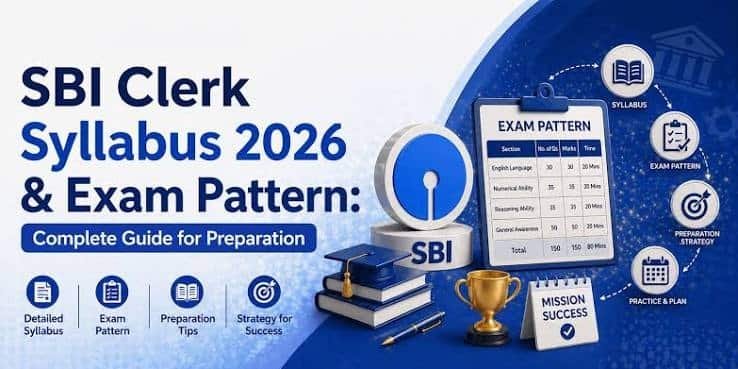
The Prelims exam consists of 100 objective-type questions worth 100 marks, to be completed within 60 minutes, split across three sections with a sectional time limit of 20 minutes each.
The three sections tested are:
- English Language — 30 questions, 30 marks
- Numerical Ability — 35 questions, 35 marks
- Reasoning Ability — 35 questions, 35 marks
Every wrong answer costs 0.25 marks, so while the difficulty level here is generally easy to moderate, candidates still need to balance speed with genuine accuracy rather than attempting every question blindly.
English Language Syllabus (Prelims and Mains)
The English syllabus remains largely consistent across both stages, though Mains pushes the difficulty and passage complexity noticeably higher. Core topics include:
- Reading comprehension
- Cloze test
- Para jumbles
- Error detection and spotting
- Fill in the blanks
- Sentence improvement and correction
- Vocabulary-based questions (synonyms, antonyms)
Since English tends to be one of the more time-consuming sections due to lengthy comprehension passages, consistent daily reading practice genuinely helps build the reading speed this section demands.
Numerical Ability and Quantitative Aptitude Syllabus
This section tests calculation speed and applied mathematical reasoning, appearing in Prelims as Numerical Ability and expanding into Quantitative Aptitude for Mains. Core topics include:
- Simplification and approximation
- Number series
- Data interpretation (tables, bar graphs, pie charts, line graphs)
- Average, ratio, and percentage
- Profit and loss
- Simple and compound interest
- Time, speed, and distance
- Mixtures and alligations
- Permutation, combination, and probability
Data Interpretation typically carries substantial weightage in both stages, so building strong calculation shortcuts directly improves your overall attempt speed, particularly in Mains where the difficulty level rises considerably.
Reasoning Ability Syllabus
Reasoning tests logical thinking under time pressure, and it’s consistently one of the sections where regular practice yields the fastest visible improvement. Core topics include:
- Puzzles and seating arrangement (linear, circular, and floor-based)
- Syllogism
- Inequality
- Coding-decoding
- Blood relations
- Direction sense
- Alphanumeric series
- Data sufficiency
- Input-output based questions
Puzzles and seating arrangement questions usually take up a significant chunk of marks in this section, and Mains typically introduces more complex, multi-layered puzzle formats compared to Prelims, so dedicating focused practice time to varied and advanced puzzle types genuinely pays off.
Main Exam Pattern: The Stage That Actually Decides Selection
The Mains exam is where your real selection gets determined, given the absence of any interview stage. It consists of 190 questions worth 200 marks, to be completed within 2 hours and 40 minutes.
Mains expands the syllabus to four sections instead of three:
- General English
- Quantitative Aptitude
- General/Financial Awareness
- Reasoning Ability and Computer Aptitude
Like Prelims, Mains also carries a negative marking of 0.25 marks per wrong answer, and each section has its own sectional time limit. The overall difficulty level in Mains is noticeably higher than Prelims, particularly in Reasoning and Quantitative Aptitude, where question complexity increases substantially compared to the screening round.
General and Financial Awareness Syllabus
This section is unique to Mains and doesn’t appear at all in Prelims, which is exactly why many candidates underprepare for it despite it being fully scoring with the right consistent approach. Topics include:
- Current affairs (national and international, generally covering the last few months)
- Banking and financial awareness (RBI policies, monetary tools, banking terminology)
- Static general knowledge (important days, headquarters, schemes)
- Government schemes and economic policies
- Awards, honours, and appointments
Since this section rewards consistent daily updating rather than last-minute cramming, building a habit of reading financial news and monthly current affairs compilations throughout your preparation period is far more effective than trying to absorb everything in the final weeks before the exam.
Reasoning Ability and Computer Aptitude Syllabus (Mains)
This combined section blends advanced reasoning with fundamental computer literacy relevant to modern banking operations. The reasoning component builds on Prelims topics with greater complexity, while the Computer Aptitude portion covers:
- Computer fundamentals and basic terminology
- Hardware and software basics
- Internet and networking basics
- MS Office applications
- Computer security and shortcuts
- History and generations of computers
Since this section blends with Reasoning marks, even moderate command over these basic computer concepts can meaningfully boost your combined score in this particular section of Mains.
Local Language Proficiency Test: What It Actually Involves
Candidates who clear Mains and receive a provisional allotment need to clear the Local Language Proficiency Test in the official language of the state they’ve been allotted to. This test simply verifies that you can read, write, and speak the regional language reasonably well, since Junior Associates regularly interact with local customers across branches.
Candidates who’ve studied the concerned regional language at the 10th or 12th standard level are usually exempted from this test, since their academic records already serve as proof of proficiency. Those without such proof, however, must clear this test to avoid disqualification, regardless of how well they performed in Mains.
Building a Preparation Strategy That Reflects Where Selection Actually Happens
Given the two-stage structure with genuinely different stakes, your preparation needs to evolve as you move from Prelims-focused practice toward the broader, higher-stakes Mains syllabus.
In your initial preparation phase, concentrate heavily on English, Reasoning, and Quantitative Aptitude, since these form the shared foundation across both stages, and clearing Prelims depends entirely on speed and accuracy here. Once you’re through Prelims, shift a significant portion of your daily study time toward General and Financial Awareness and Computer Aptitude, since these are entirely new additions that Prelims preparation alone won’t cover.
Since there’s no interview stage to fall back on, treat Mains preparation with genuine intensity rather than assuming a decent Prelims score guarantees eventual selection. Daily newspaper reading, monthly current affairs revision, and regular full-length mock tests under strict sectional timing genuinely make the biggest difference here, since this exam rewards consistent practice far more than any single burst of last-minute revision.
FAQs
Q1. Since there’s no interview stage in SBI Clerk recruitment, does that mean Mains alone decides everything?
Yes, your Mains score is the sole basis for final merit, along with clearing the Local Language Proficiency Test if applicable, so there’s no additional personality-based round to compensate for a weaker written performance, making thorough Mains preparation absolutely essential.
Q2. Does my Prelims score carry forward or add to my Mains marks in any way?
No, Prelims is purely qualifying in nature to shortlist candidates for Mains. Your final merit and selection are based entirely on your Mains exam score, with Prelims marks playing no role in the final calculation.
Q3. Can I skip the Local Language Proficiency Test if I studied a different language in school?
You generally cannot skip it unless you’ve studied the specific local language of your allotted state at the 10th or 12th standard level, which serves as automatic proof of proficiency, so it’s worth checking your own academic record against the exemption criteria before assuming you’ll need to appear for it.
Q4. Since General and Financial Awareness only appears in Mains, when should I start preparing for it?
Ideally right alongside your Prelims preparation, not after clearing it, since current affairs and banking awareness build up gradually over weeks and months, so starting early through daily reading habits works far better than compressing that entire section into the short gap between Prelims and Mains results.